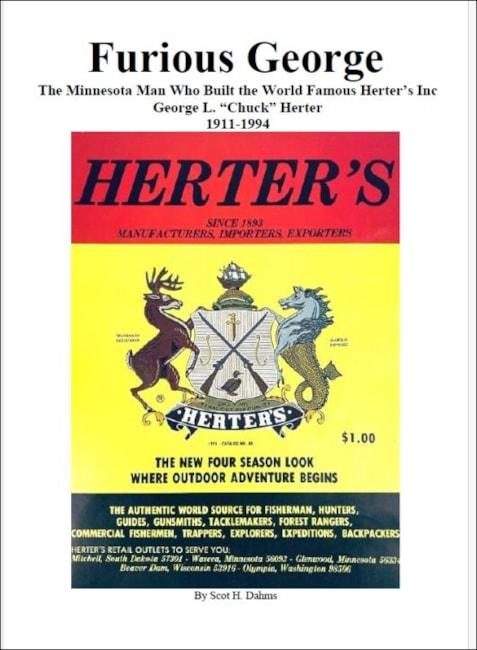
Furious George
The Minnesota Man Who Built the World Famous Herter’s Inc.
George L. “Chuck” Herter 1911-1994
George L. “Chuck” Herter was an interesting man to say the least, but his interesting nature may have been spawned by mental health issues. This book includes discussions on inferiority complex, Post Traumatic Stress Disorder and Bipolar issues. These discussions should not provide any reason to discount his contributions and should instead say that he made these contributions, in spite of, not because of, these issues...
George L. “Chuck” Herter was an interesting man to say the least, but his interesting nature may have been spawned by mental health issues. This book includes discussions on inferiority complex, Post Traumatic Stress Disorder and Bipolar issues. These discussions should not provide any reason to discount his contributions and should instead say that he made these contributions, in spite of, not because of, these issues. That being said, George’s controversial viewpoints should not be condoned because of these issues.
To provide a complete understanding of his uniqueness, comments are provided by others who may not have been aware of his mental health issues. These positions and opinions are not necessarily shared by the author but are included to provide a perceptional overview of the man, from all perspectives.
I did not fact check all quotes made by George. You may find contradictions with what George said one time to the next.
I included the good, the bad and the onery in this book. The good is George’s younger life when the town of Waseca cherished their hometown son and he had dreams of being an outdoor artist. He seemed to be a well-adjusted young man with the height of George’s social interactions occurring when he attended the University of Minnesota. Building on his interest in being a cartoonist, George drew at least sixty images for the Ski-U-Mah at the University of Minnesota. I included several in this book. The bad is George’s life during and after World War II where Post Traumatic Stress Disorder brought out mental health issues such as being Bipolar. The onery includes George’s sparing with attorneys during his many court battles.
George was involved in at least ten court battles. Some he won, some he lost and some were a draw. The court battles with D.H. Blair & Company, Remington Arms Company, Woodstream and The Governor and Company of Adventurers of England Trading into Hudson’s Bay were particularly interesting when looking at the sparing George did with the attorneys. I included this sparing verbatim to show the unique character that George was. Nothing shows a person’s personality better than the words that came directly out of their mouth.
During these court hearings, George was quite evasive about answering all questions but particularly those about the history of the business. In the Hudson’s Bay Company case after Seeburg had taken over, many of the business facts were shared and included in this book.
During the D.H. Blair & Company case, George provided a self-diagnosis of having an inferiority complex. An inferiority complex is a deep-seated, chronic feeling of inadequacy or insecurity, often stemming from childhood experiences, trauma, or social pressures, which can lead to social withdrawal or overcompensation through aggressive, perfectionist, or competitive behaviors. This would drive George to build the business to the level he did using the methods he used.
Although much of George’s issues are pointed to World War II as the turning point in his personality. This may have been the trigger, but I think the underlaying of these issues came from his early life and feeling of inferiority when having to follow his father’s wide path of success along with his mother and sister’s success as well.
Based on activities and involvement in the World War I fund drive and the push for law enforcement, George’s father could be thought of as a stern and authoritative figure which could easily conflict with George’s free-spirited personality causing a rift discussed by Jacques. Berthe noted that George’s mother was tough on him as well. George said during the D.H. Blair & Company case that he would not fire or punish those who stole money or products from Herter’s, or press charges.
I intentionally tried to keep comments from his books and catalogs out of this book unless noted by other sources, as these can be obtained through commercial outlets. My goal was to provide insight into the man and his influence on the outdoor world. I hope I attained this goal, but you be the judge. It was a challenge that can only be started with George’s own words.
I don’t want to be known and rarely tell people my right name. I never allow anyone to take my picture.